 2025.2.17
 News
News
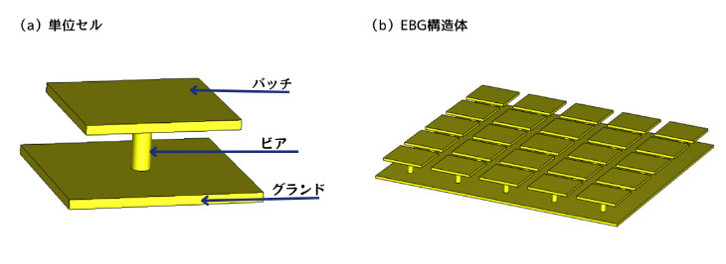
An EBG antenna utilizes periodically arranged structures to create bandgap regions that block electromagnetic waves of specific frequencies from propagating within the structure, while guiding energy in desired directions. This enables high radiation efficiency, suppression of surface waves, and enhanced directivity. EBG antennas are commonly implemented using “mushroom-shaped” or specially designed geometric structures, allowing for more compact antenna size with superior performance.
A simple analogy is to imagine a room with “echo walls.” The EBG structure is like specially designed sound-absorbing panels on the walls that prevent sound (electromagnetic waves) from traveling in certain directions, allowing sound to exit only through the desired opening, making it more focused and louder at that exit.
Advantages of EBG Antennas:
1. Bandgap Concept:
EBG structures consist of periodically arranged unit cells (such as metal vias and patches on a grounded plane). The capacitive and inductive effects between these units create a “bandgap” at specific frequency ranges, preventing electromagnetic wave propagation.
2. High-Impedance Characteristics:
Within the bandgap frequency range, EBG structures exhibit high impedance, effectively blocking electromagnetic waves—especially surface waves—from propagating through the structure, thereby reducing energy loss.
3. Electromagnetic Wave Control:
By adjusting the size and design of the EBG structure, the bandgap range and characteristics can be precisely controlled, directing electromagnetic energy from the antenna toward desired directions to achieve unidirectional radiation or narrow beam width.
Applications and Functions of EBG Antennas:
• Unidirectional Radiation:
Using an EBG structure as a backing layer allows the antenna to radiate in only one direction, improving communication efficiency.
• Surface Wave Suppression:
An EBG ground plane beneath the antenna suppresses harmful surface waves propagating along the structure, enhancing the radiation pattern.
• Miniaturization and High Performance:
EBG unit cells (such as mushroom-type structures) effectively confine electromagnetic fields, enabling antennas to operate at lower frequencies while maintaining compact size, high gain, and wide bandwidth.
• Metamaterial Applications:
Designing EBG structures into inverted-F antennas (EBG-Inv F) enables metamaterial antennas with unique electromagnetic responses and high directivity.
This antenna is the latest technology developed by Japan’s SANSEI Electric and capable of maintaining stable signal transmission in high-frequency environments. TONE-SHINE stated that it plans to collaborate with major communications equipment manufacturers for testing, with mass production scheduled for the second half of 2027. The antenna is expected to be launched simultaneously in Asian, European, and American markets, further expanding its global presence.